Planning vs Strategy, Tips for riding a Sh*tty Bus & Trail Oriented Development — I Hope This Helps 👍🏽
Happy Black History Month ✊🏾. Commentary on race in planning, a slow light rail line, the difference between plan and strategy, and the Swamp Rabbit Trail in this edition of I Hope This Helps!
Welcome to I Hope This Helps👍🏽, a roundup of tidbits I’ve encountered that furthered my thinking about cities, people, and life. From sustainable transportation, housing, and design to the social forces shaping our daily lives, I take a broad lens in this review. Whether you're a planner, advocate, or just curious about the world around you, I hope you’ll find something here that resonates. Take what helps. Leave what doesn’t.
1️⃣Finch West LRT
In December 2025, after being canceled and restarted several time, the Finch West LRT line, also known as Line 6, opened in Toronto, Ontario Canada. Operated by the Toronto Transit Commission (TTC), this 18 stop line starts at the Finch West station on the existing Line 1 and travels 6.4 miles west before terminating at the far end of a parking lot adjacent to Humber College. It offers peak frequencies of every 6.5 minutes, and off peak frequencies between 9 and 13 minutes. In this video, the popular urbanist Youtube channel Not Just Bikes reviews the Finch West LRT, comparing it to several international examples of modern light rail systems he’s experienced firsthand.
Before opining about the service, the creator gave a disclaimer on the potentially negative tone of the video (and offered a less negative alternative for those looking for lighter fare). For what it’s worth, I respect his candor. Advocating for more transit, particularly in the United States can be a tightrope walk. You don’t want to be overly critical, killing nascent ideas before they have the chance to get off the ground. However, when long awaited transit projects fail on the basics, it leaves behind a big fat case study for sincere enemies of public transit1 on why transit investment is a waste of money. These case studies, sincere or otherwise, make it that much harder the next time transit investment is on the table.
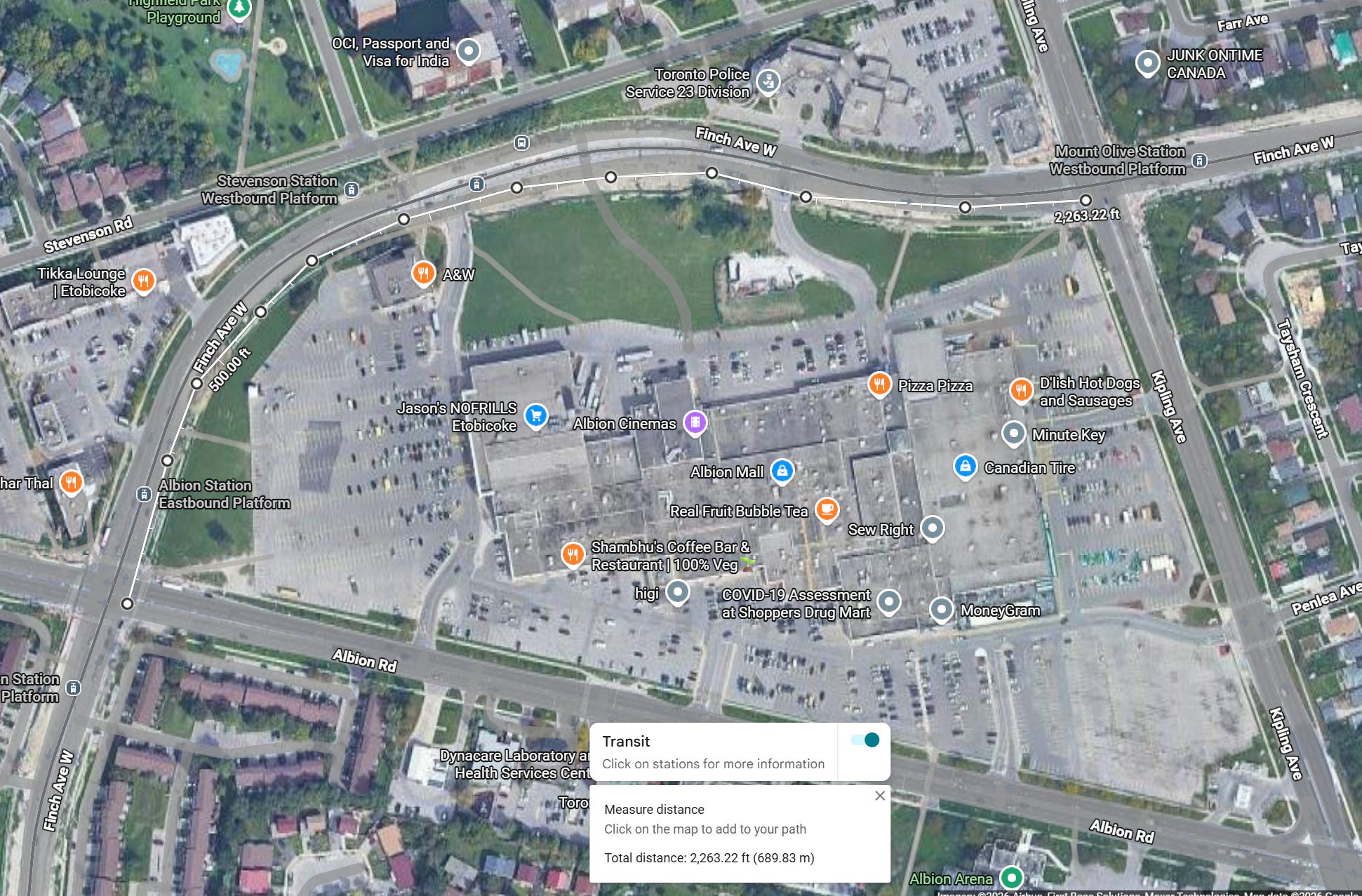
His major finding, and the source of his ire? The line is SLOW 🐢. Despite operating in its own dedicated right of way (ROW), the line opened with a maximum line speed of about 35 mph, despite the 4-6 lane road its ROW sits in having higher speed limits. Notably, the line speed restriction drops to about 16 mph when the train is passing through intersections. Fortunately, the line doesn’t always have to slow to this speed before entering the intersection. It might already be sitting, waiting for left turning traffic to clear before getting the green light to proceed through the intersection…at no more than 16 mph. Throw in stretches like the segment between the Mount Olive and the Albion Station where, over the course of 0.42 miles you encounter 3 stations, and you have the perfect recipe for a slow transit service.
Before leveling these criticisms of the line, the video creator stated that “I’m not a public transit expert, but I play one one TV, and I know what it’s like to ride a modern LRT line.” As a (self proclaimed) public transit expert, I think he’s probably selling himself short. Between politicians hungry for a ribbon cutting to tout how much money they’ve “invested” in a community, consultants and construction companies looking for a paycheck, and the ever-present, existential fear of inconveniencing someone in a car, it’s concerningly easy to spend a lot of public money on a big, flashy transit project that wholly ignores the transit rider.
Thanks for reading Thoughts About Cities! Subscribe for free to receive new posts and support my work.
2️⃣ Happy Black History Month ✊🏾
If it hasn’t come up yet, I’m a black guy. Here in the United States, February is identified as Black History month, to recognize the accomplishments of Black Americans that came before us whose roads were filled with far more adversity than I can begin to fathom. I wouldn’t be here today if people that looked like me didn’t find the strength and will to survive the Transatlantic Slave Trade, and the centuries long battle to be recognized as full and complete citizens, imbued with all of the rights this great nation was founded on.
I generally don’t discuss race much on this page. Partially because the solutions to a lot of the challenges that cities face (i.e. - housing affordability, perceptions of safety, walkability) are intertwined with, but not specific to race. Partially because the wanton abuse of the race card by prominent black leaders in Chicago (and beyond) to score cheap political points or to absolve themselves of negligence has really pissed in the pot for meaningful discourse. Partially because this is my page, and I’m not here to argue with people on the internet about how racist highways are. Partially because I stand by the old cliche that race is a social construct.
Yes, there are phenotypical (physical) differences between people, skin color being a more obvious one. However, these differences in and of themselves don’t dictate individual outcomes much (unless maybe the outcome is avoiding a sunburn). Underneath these differences, we’re all genetically pretty similar. Unfortunately, our monkey brains love to lump people into crude boxes based on arbitrary differences, the more obvious the better. Worse, this prehistoric relic takes these crude boxes and indulges itself applying all kinds of tired assumptions and half-baked value judgements. Value judgements that might echo whatever set of morals we were raised to believe, but are ultimately informed by the life lived by the individual making the judgement.
Those individualized boxes of assumptions, as well as the actions, policies, normalized behaviors and ingrained beliefs enabled by them, build our conception of race. Skin color is just one of the more obvious tools we use to define people, often to the detriment of seeing them as the wholly unique beings that they are.
“Remember, assumptions make an ass out of you and me”
~Your middle school teacher (probably)
I once heard policymaking described as ”an effort to freeze and perpetuate a particular flow of power.” I think that understanding provides an informative lens to view the relationship between race, policy and power. Race is mostly benign on its own. However, policy is built by people, and people come pre loaded with assumptions. When racial assumptions make their way into policy, the damage can echo for generations, leaving structural scars and triggering consequences that surface decades later.
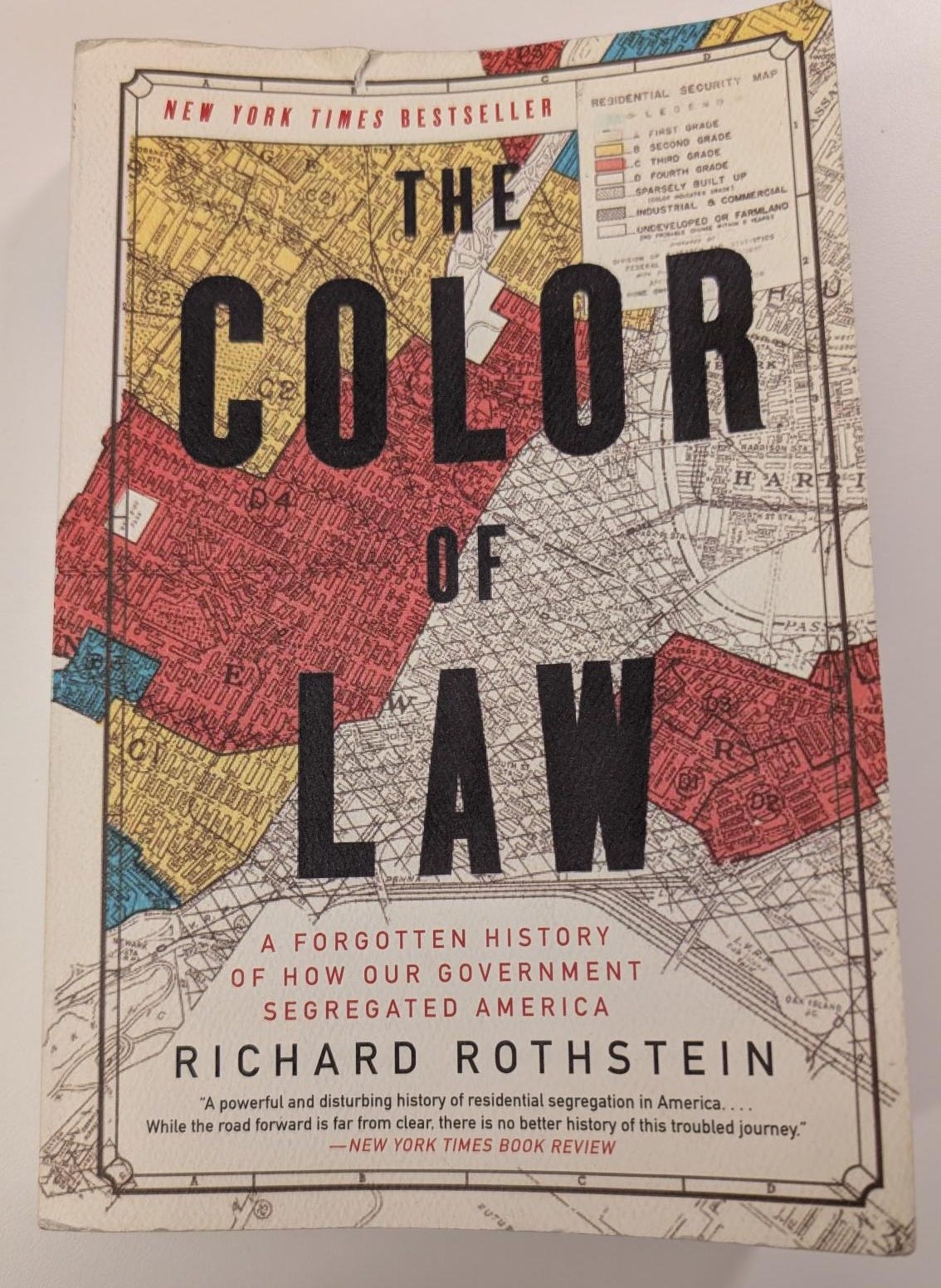
Check out The Color of Law by Richard Rothstein if you want a well researched deep dive into how racially informed federal lending and land use policy throughout the 1900s left racial distortions in homeownership and distribution that we’re still experiencing in US housing markets today.
Race is a messy concept, and meaningful conversations about race are even messier. If planning wants to continue its fixation on race, it must learn to embrace that messiness when attempting to host conversations about race. The racial box checking exercise that permeates most of the planning process, dominated by mapping “BIPOC” communities, ensuring surveys talk to enough black people, and creating plenty of opportunity for the public to lambast every project for being either too “woke” or not “woke” enough, is performative at best, and overly reductive and obstructive at worst. Conversations around race need to be had with sincerity, or not at all. Fortunately, for those uninterested, or ill-equipped to meaningfully have these conversations, there’s a workaround. Just don’t. Skip the conversation altogether, and focus on the already hard enough work of building vibrant communities that let people of all backgrounds and persuasions thrive. The whole “this plan isn’t racist” box checking exercise does little to actually prevent racist outcomes, but it does increase the lift required to get any project across the finish line. As long as you’re not demolishing entire neighborhoods to build highways, or explicitly barring federal lending to black households, you’re doing better than planners of yore.
Ultimately, when dealing with race and what it means to engage with the world as a black person, I like the guidance offered by Daryl Fairweather, PhD in her book, Hate the Game: Economic Cheat Codes for Life, Love, and Work. Being black is just a detail of my starting condition. What I do with that starting condition is up to me.
3️⃣Why You Should Still Take That Sh*tty Bus
This video starts with a challenge to anybody that is interested in taking transit or seeing transit improved in their city, but presently find themselves driving most places. That challenge? Take that sh*tty bus. Good Transit can be hard to find in a lot of the United States. In many places, against a backdrop of anemic operating funding, sprawling land use, unrelenting parking minimums and cyclical bouts of austerity politics, alright transit is about the best we can expect. In those places, transit is probably not going to be able to replace the car for every trip, at least not in the short term. Fortunately, it doesn’t have to. The trick to getting the most out of an alright transit system is to find the trips where transit does makes sense for you, and leaving the car behind for those trips. This might not seem like much in the grand scheme of things, but transit’s success (particularly by its detractors) is measured by how full the bus is, and often more subtly by who is riding the bus. The controversial action of actually taking the bus that’s there when it makes sense for your travel helps fill those buses and diversify the caricature of the “typical transit rider” decision makers conjure in their minds when advocating for (or against) transit service.
If you’re transit curious, but still nervous about hopping on the bus, look for the one bus trips. Transfers introduce a lot of variability, and if you’re not a confident transit rider, a bad transfer experience might turn you off of the whole exercise. One bus trips also make the return journey simple. If there is a bus route near you, see where it can take you without requiring a transfer to another route. You’ll probably be surprised at how many fun, useful destinations in your neighborhood are just one bus ride away.
If you want more tips on how to work a sh*tty bus into your life (with hopes that it might become a little less sh*tty), check out this video!
4️⃣He Took A Sh*tty Bus (and met nice people)
In this video, Evan Edinger accepted the challenge presented by the last video and took a series of increasingly challenging transit trips, mostly just to share the experience and contrast it with his time riding the buses around London. For his first trip, he took an express bus from a suburb to the central city, this time Philadelphia. This traditional enough travel pattern was well served by an express bus, so the trip was painless, if not uneventful. After exploring Reading Terminal Market, Evan set off on his next journey, traveling from the central city to a walkable suburb. This trip was accomplishable via a PATCO train, making for another, smooth if not uneventful transit journey. After exploring English Gardener Gift Shop in Haddonfield, NJ Evan took off on his most trying journey of the day; the elusive suburb to suburb trip. I’ll let you watch the video to see how it went. Along the way, Evan manages to strike up conversation with other transit riders, and broach some timely discussions about the human side of transit, the negative stigmas unfairly attached to transit riders, the importance of benches and bus shelters, and Jaywalking.
5️⃣A Plan it Not a Strategy from the Harvard Business Review
In this Quick Study from the Harvard Business review, Roger Martin, a Professor Emeritus from the University of Toronto Rotman School of Management, defines planning, strategy, and strategic planning, making the assertion that strategic planning actually has next to nothing to do with strategy. He defines planning as detailing the actions an organization intends to carry out. Strategic planning is just the package of all of these individual planning efforts.
Strategy, he defines as an “Integrated set of choices that position an organization on a playing field of their choice, in a way that they win.” Strategy informs why an organization is where it is, and how it intends to maintain a competitive advantage. Although the government is not a business, many of the lessons that apply to running a successful business can still be applied in pursuit of running a successful government.
Strategy requires a theory of being. An understanding of why it makes most sense for your organization to be in the place that it’s at, spending the resources that it’s spending, doing the thing that it’s doing. This theory of being can be difficult to establish, maintain and communicate in any large organization. In a government, where that theory of being is (ostensibly) derived from the consensus of the people, sincere misunderstanding and perverse incentives conspire to elevate the difficulty of the task of maintaining this theory of being.
This is why many leaders lean on the certainty offered by planning. If you can’t convincingly answer why your organization exists, and what value it brings, at least you can point to a list of things you accomplished from the strategic plan. Learn more about plans and strategies below!
6️⃣Some Trail Oriented Development in Greenville, SC
To me, cities are just places for people get together and do whatever the hell. From this whatever the hell, life emerges. From this perspective, the job of the government is not to dictate how that life emerges, but to facilitate the life that’s already emerging in the places being governed. This story of the Swamp Rabbit Trail in Greenville, SC is a prime example of government living this mantra.
The Swamp Rabbit Trail is a network of rails to trails multi-use paths snaking through Greenville, SC, named after the native Swamp Rabbit. When Swamp Rabbit Cafe and Grocery opened up in Greenville, SC fronting the Swamp Rabbit trail instead of the road, it quickly became a frequent destination for the two-wheeled community in Greenville. As the popularity of the trail grew, there were increasing demands to add capacity and amenities to the trail. Unfortunately, the county didn’t have the funding (or engineering warrants) to respond to the requests.
However, in the spirit of facilitating the life that was already emerging, they got creative. To raise funds, they sold naming rights to the trail, with small sections going for as little as $25. This granular approach allowed community members to literally buy into the concept of the trail, and sowed personal connections along its length. Instead of paying to construct bathrooms, the county approached adjacent businesses and offered them signage and branding along the trail if they would allow their business to be listed as a public restroom along the trail. Instead of building parking lots for the trail, the forged shared parking agreements with churches near the trail. Most notably, they keep the trail open 24/7, identifying it as a transportation corridor and potentially opening it up to transportation funding sources. To drive this point home, the trail comes complete with centerline markings, mile markers and MUTCD compliant signage.
As the trail has been built up over time, it’s become a regional asset, with businesses near the trail seeing quantifiable sales growth, and new residential developments explicitly offering the amenity of “life on the trail.” It’s amazing what we can accomplish once we stop planning, and just figure out what it takes to do.
📰In Other News
Fares are returning to RideKC buses after 6 years of fare free transit (KCUR)
Johnson County, KS forms United Link service to support FIFA World Cup transportation needs in Kansas City (Mass Transit Magazine)
👀A Moment for Wanderizm
Lately, I’ve started to fill my screen time with more of what I’m starting to call “passive content.” This type of content features mostly unedited footage of life unfolding. Because I’m a relentlessly one-dimensional transportation planner, this takes the form of POV bike ride footage or videos of people walking around Germany or Japan. In an algorithmic media ecosystem where much of what you see is tailored to your specific interest and designed to keep you somewhat checked in to whatever narrative is being presenting, passive content offers a reprieve. This is particularly helpful when none of my books are hitting, and I just want to loaf on the couch and stop thinking for a bit.
For me, the appeal of this type of content is it doesn’t command your attention. It simply presents a perspective of life, and invites you to check in when something piques your interest, and check back out when the moment passes.
I also have this half-baked social theory that we’ve conditioned ourselves to think better with visual stimulation. Since passive content can shift effortlessly between the background and the foreground, I’ve found it to be perfect for sparking conversation and falling into the background once conversation gets going.
Lately I’ve been getting my passive content fix watching footage from the top of London’s double decker buses. If you give passive content a try, let me know what your experience was like!
📚 Explore My Bookshop Wishlist If you enjoy my writing and want to support it in a small but meaningful way, consider buying me a book from my Bookshop.org wishlist. It’s a curated list of books I’ve been looking at but haven’t had gotten around to reading. Help me read more books! 🙏🏽
Totally agree about your passive content opinions! It can be a great way to create some "social lubricant" for lack of a better phrase.
I think it is related to how our brains operate while having visual cues. I know I am a person who will wander while on a phone call and I feel like these two things might be related! Having context where the scenery is changing can change the neuroscience around us apparently!
Here is an interesting article I found about the benefits of walking while talking and how it can cause us to be more efficient and creative! I think the same points apply to what you were saying 😁


Totally agree about your passive content opinions! It can be a great way to create some "social lubricant" for lack of a better phrase.
I think it is related to how our brains operate while having visual cues. I know I am a person who will wander while on a phone call and I feel like these two things might be related! Having context where the scenery is changing can change the neuroscience around us apparently!
Here is an interesting article I found about the benefits of walking while talking and how it can cause us to be more efficient and creative! I think the same points apply to what you were saying 😁
https://medium.com/wellnesscaptain/why-do-we-walk-around-when-talking-on-the-phone-832a2e89a0c
Take the sh%$ty bus: love it.