Layover (n) or (v). Transit Planning - Time scheduled into a transit route for the vehicle to recover any time lost in the last lap and start the next lap on time.
At most transit authorities1 drivers pick the route they drive based on seniority, with the longest serving bus driver picking first and the newest drivers fighting for the scraps2.
From this process, preferences start to emerge pretty quickly3. Some are obvious. Drivers tend to avoid split shifts.
Split Shift (n) - A work schedule where a driver’s workday is divided into two or more distinct work periods, separated by a non-working period. For transit, this typically means driving during both rush hours, with a gap in the midday. Peak oriented scheduling4 creates split shifts.5
Drivers also tend to avoid overnight service, and prefer weekday service to weekend service. The early straights are always amongst the first to be picked.
Early Straight (n). Informal - A straight shift is a continuous work shift (i.e. not a split shift.) An early straight is a straight shift that starts in the morning, often pulling the bus out from the garage.
Why do bus drivers tend to pick the early straights? Entropy.
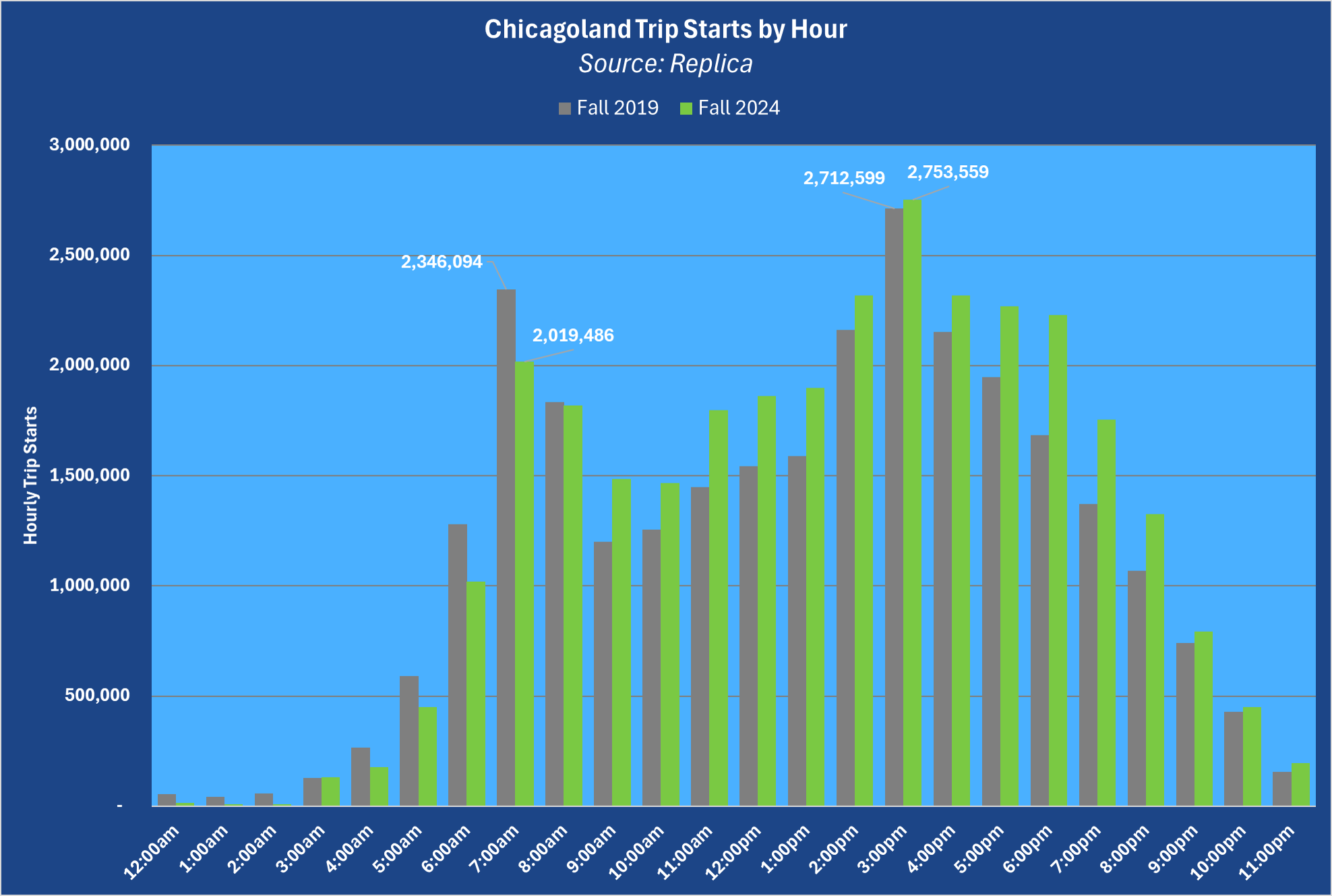
The vibe behind the wheel of a bus tends to get more chaotic, not less as the day goes on. There are two big reasons for this. First, the AM peak is generally calmer than the PM peak.
Trips starting within Cook, DuPage, Kane, Lake, McHenry, and Will Counties
Second, compounding delays. Problems from the morning tend to linger into the day, as fresh problems present themselves. Even with accurate runtimes…
The first and best preparation to ensure timely transit service can coexist with life is the layover. The layover gives the bus service a chance to recover any delays encountered in the last trip and start the next trip on time. The layover also gives the person driving the bus a fresh chance to Reflect, Acknowledge, Accept & Move On from whatever happened on the last trip, and prepare the best version of themselves for the next trip.
Less pretentiously, the layover is a driver’s time to 10-100, check their phone, grab a snack, read a couple pages of their book, or hit a quick vinyasa.
Best Practice: Ideally, bus lines should begin and end at transit centers or major destinations like malls or colleges. At minimum, they must end where there is a dignified bathroom for the driver.
Reasonable layovers, paired with reliable runtimes are the functional and cultural bedrock of a timely transit service. When I’m building a new transit service, or updating an existing service, this is my starting layover assumption:
The layover should be at least 15% of the runtime.
Time for Some Transit Math ➗✖️
Let’s apply this concept (I’ll keep it light).
❓Assuming a minimum 15% layover, how much layover would a route with a 50 minute runtime require?
Runtime = 50 min
Layover = Runtime * Layover = 50 min * 15% = 7.5 min
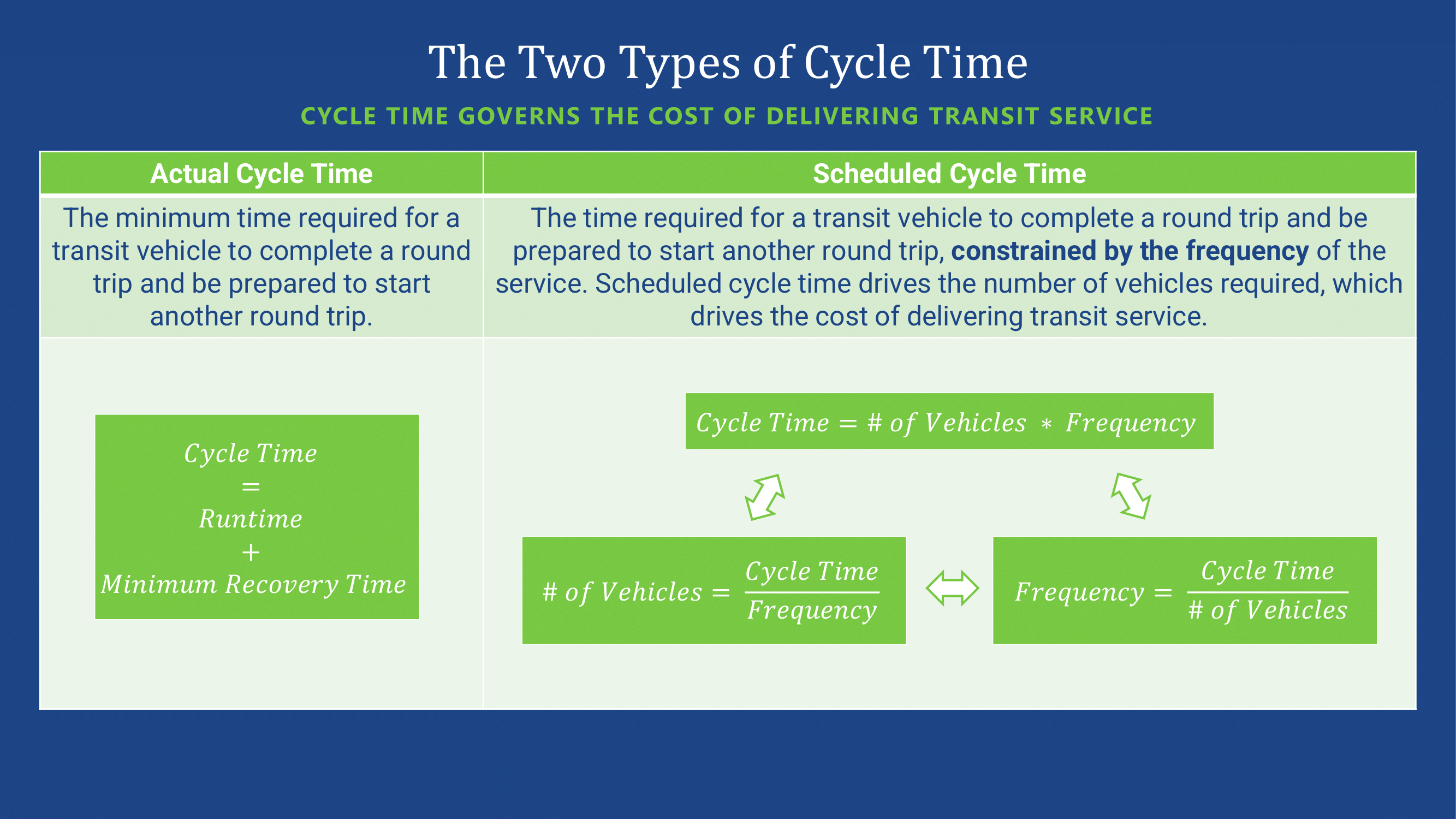
A route with a 50 minute runtime would get at least a 7.5 minute layover. This makes the actualcycle time for this route 57.5 minutes.
Often, the difference between actual and scheduled cycle time mean layovers exceed the 15% minimum, which helps keep the bus on time, and offers a nice perk for drivers6.
❓If the previous route runs every 60 minutes, how many vehicles will it take to operate this route?
Vehicles = Cycle Time / Frequency = 57.5 minutes / 60 minutes = 0.96 vehicles
0.96 Vehicle → 1 Vehicle
Since you can’t operate 0.96 of a bus you have to round up to 1, meaning this route takes 1 bus to run every 60 minutes.
❓What’s the scheduled cycle time for this route?
Scheduled Cycle Time = # of Vehicles * Frequency = 1 Vehicle * 60 min = 60 min
The scheduled cycle time for the route is 60 minutes. Of that 60 minutes, 50 minutes are runtime, 7.5 minutes are layover (15%), and 2.5 minutes are extra time above the 15% minimum layover required. The effective layover percentage is 20% (10 min/50 min)7.
Now, let’s assume that the route has been running for a while and the runtimes need to be increased to account for additional traffic along the corridor.
❓The route now has a 55 minute runtime. What is the actual cycle time for the route?
Runtime = 55 min
Layover = Runtime * Layover = 55 min * 15% = 8.25 min
Actual Cycle Time = Runtime + Minimum Layover = 55 min + 8.25 min = 63.25 min
❓If the route runs every 60 minutes, how many vehicles will it take to operate this route?
Vehicles = Cycle Time / Frequency = 63.25 minutes / 60 minutes = 1.05 Vehicles → 2 vehicle
Again, since you can’t have fractional buses, you have to round up to 2, meaning this route takes 2 buses to run every 60 minutes.
❓What’s your scheduled cycle time for this route?
Scheduled Cycle Time = # of Vehicles * Frequency = 2 Vehicle * 60 min = 120 min
The scheduled cycle time of the route is 120 minutes now. Of that 120 minutes, 55 minutes are runtime, 8.25 minutes are layover (15%), and 56.75 minutes are extra time above the 15% minimum layover required. The effective layover percentage is 118% (65/55 min). Obviously, something more productive should be done with that extra time.
Some valid solutions are to find ways to speed the bus up, or to reduce the frequency of the route to every 70 minutes, or to extend the route since you have the extra time. The easiest “solution” is to cut the layover to 5 minutes (9%) so the actual and scheduled cycle times are 60 minutes and the route can be operated with 1 vehicle.
What Happens When You Cheat The Layover?
When a bus driver reaches the end of the line and finds that their expected ten minute break is actually three minutes, they’re faced with a choice. They can opt for altruism and sacrifice their layover to ensure the next trip starts on time, or they can take the break they were expecting and start the next trip late.
Loading...
If all the bus drivers turn and burn, things might look fine in the short term, but eventually people burn out. Once drivers start to burn out, service reliability (as well as safety, customer service and overall morale) suffers.
If all the bus drivers just take their break, they’re probably already burned out. They’ve realized that this route was not designed to be on-time, and resolved that it’s not worth their energy to chase their tail fighting a losing battle8. Once this mindset takes hold of a transit authority, it can become nearly impossible to build a culture of timeliness that delivers high-quality, reliable transit service.
Layover keeps the transit service timely and bus drivers sane. Unfortunately, when other operational or financial demands present themselves, layover is often the first thing cheated. Regardless of the rationale, the choice to cut layover undermines the reliable delivery of Good Transit.
Recently I was talking with my husband after a bus ride, and he said "that experience was not worth $2.50; I'd rather walk” (not related to the header picture). That obviously made me sad as a transit planner, but after we kept talking (and I got over myself), I realized that he was right. Transit types like me (and probably you if you’re reading this) …
I mentioned earlier that the layover gives the person operating the bus a chance to pause and take a quiet moment before diving headfirst into the next trip. The value of pausing doesn’t stop at transit. We’re all living in an attention economy moving at the pace of Artificial Intelligence (AI), catalyzed by disruptors at the highest levels of our most powerful institutions. All of this creates a sense of urgency, similar to the urgency that encourages a bus driver to turn and burn instead of taking their break. That impulse will burn you out. You owe it to the world to be the best version of yourself9. Call it personal layover. Your personal layover can be as formal as exercise, yoga, prayer, or meditation, or as simple as savoring your morning coffee, actually reading that article instead of skimming it, or setting your phone to “do not disturb” for a while. Just take a minute to slow down and truly be present.
Thanks for reading Thoughts About Cities! Subscribe for free to receive new posts and support my work.
📚 Explore My Bookshop Wishlist Thanks for reading! If you enjoy my writing and want to support it in a small but meaningful way, consider buying me a book from my Bookshop.org wishlist. It’s a curated list of what’s been shaping my thinking — and every purchase supports independent bookstores too.
Generally, the more acute the peaking, the more split shifts your service will require. Ex. A 15/30 (peak frequency / off peak frequency) will generally require less split shifts than a 15/60. This is another advantage of consistent, all day schedules
This needs to be kept within reason. If you have recurring layover percentages above ~50%, you probably have room to optimize your service. This could mean double checking the blocking to ensure service can’t be run with fewer vehicles, searching for interlining opportunities, adjusting the service frequency or extending the route, amongst a host of other things